Saturday, 14 May 2022

{Sex and Violence}[4th October 1990]

[Redbook8:8-9][19901004:1215]{Sex and Violence}[4th October 1990]


19901004.1215

(Thu)


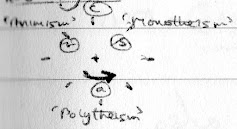
A reference in the Guardian this week to censors being more concerned with sex than with violence – as usual – and being basically right-wing politicians and fundamentalists (this is in the U.S.A.) – suggests the following C[ircles] A[nalysis] and S[ynthesis] description of an un-original analysis:


*


Censorship is essentially an activity of the Right: the control and inhibition of the free flow of information, eg Ordination i/c Creation (S~>j~), Outward (or Willed) Action i/c Revelation (M~>g~).


*{And the Right tendency to favour relaxation of controls to increase economic activity may be contrasted with the Left tendency to prefer increased (central) planning and co-ordination for the same end:


}

[Hmm....]


[continued]


[PostedBlogger14for15052022]


{Circle Curriculum}[4th October 1990]

[Redbook8:7][19901004:0050]{Circle Curriculum}[4th October 1990]


(03)

19901004.0050


Practically, essential rounded school curriculum:


What have I left out?*


Full working day (to allow both parents to work),

40 x 45min+ periods (5 periods x8 subjects = 40),

Breakfast, lunch and supper available at school.

= 30 hours, + 1 hour per day meals

Citizenship/Religion/ethics in c15 min[ute]s at start, Assembly.

+ 1 hour per day split for breaks between lessons, c5 min[ute]s, & Assembly.


*[Drama, dance &c; religion.... presumably languages are implied under ‘multi-lingual’]


[PostedBlogger14052022]


Friday, 13 May 2022

{Social Evolution [continued (6)]}[3rd October 1990]

[Redbook8:6][19901003:1045b]{Social Evolution [continued (6)]}[3rd October 1990]


.1045

[continued]


‘Cyclical and one-directional changes may be combined in one way or another. Very often short-term changes are cyclical while long-term development is in one direction. Figures on the production rates of industrialising countries conform, more or less, to this pattern, short-term business cycles occurring within long-term economic growth.

‘All of these pattern models cannot be applied simply and easily to social reality.* They are at best approximations of parts of social reality. Comparing the model with the reality is not always possible because of a lack of reliable data. Moreover, and more importantly, many social processes do not lend themselves to precise quantitative measurement.’

**


*(sic)


**– E[ncyclopaedia] B[ritannica] 27:418

[from ibid, 414ff,‘Social Structure and Change’]


[PostedBlogger13052022]

Tuesday, 10 May 2022

{Social Evolution [continued (5)]}[3rd October 1990]

[Redbook8:6][19901003:1045]{Social Evolution [continued (5)]}[3rd October 1990]


.1045


‘A pattern of long-term growth may also conform to a three-stage S-curve: at the beginning of the period under consideration the change is almost imperceptibly slow, then [it] accelerates, then slackens, until it approaches a supposed upper limit.’

*

This pattern of one-directional change, if applied to cyclical change, would presumably result in relative speeds similar to those of a planet in orbit round the Sun – the end of the ellipse nearest [to] the Sun being equivalent to the C[ircles] A[nalysis] and S[ynthesis] degree C, where the speed is grestest per Kepler’s 2nd law: ‘The line segment SP connecting the sun and the planet sweeps out equal areas in equal times’.**


*– E[ncyclopaedia] B[ritannica] 27:417


**ref eg ‘Mathematic and the Unexpected’, Ivar Ekeland, [1988, University of Chicago Press,] p1


[continued]


[PostedBlogger10for12052022]

{Social Evolution [continued (4)]}[3rd October 1990]

[Redbook8:6][19901003:1620g]{Social Evolution [continued (4)]}[3rd October 1990]


19901003.1620 (Wed)

[continued]


‘The originality of the Marxian theory of social development* lay in its combination of dialectics and gradualism. In Marx’s view social development was a dialectical process; the transition from one stage to another took place through a revolutionary transformation, which was preceded by increasing deterioration of society and intensifying class struggles. Underlying this discontinuous development was the more gradual development of the forces of production (technology and organisation of labour).’

**


*[See last previous entry]


** –ibid [E[ncyclopaedia] B[ritannica] 27:416]


[continued]


[PostedBlogger10for11052022]


{Social Evolution [continued (3)]}[3rd October 1990]

[Redbook8:5][19901003:1620f]{Social Evolution [continued (3)]}[3rd October 1990]


19901003.1620 (Wed)

[continued]


‘Marx and Friedrich Engels too were highly influenced by evolutionary ideas.  The Marxian distinctions between primitive communism, the Asiatic mode of production, ancient slavery, feudalism, capitalism, and future socialism may be interpreted as a list of stages in one evolutionary development, although the Asiatic mode did not fit well in this scheme.’

*


**


*– ibid [E[ncyclopaedia] B[ritannica] 27:] 416


**As always:***

→ Dominant/Primary

---> Secondary/Subordinate


***[In fact, in (some/most) other diagrams a hatched or broken line, arrow or symbol indicates less certainty than a solid one]


[continued]


[PostedBlogger10052022]

Sunday, 8 May 2022

{Social Evolution [continued]}[3rd October 1990]

[Redbook8:5][19901003:1620e]{Social Evolution [continued]}[3rd October 1990]


19901003.1620 (Wed)

[continued]


‘The most encompassing theory of social evolution was developed by Herbert Spencer, who, unlike Comte, linked social evolution to biological evolution. According to Spencer, biological organisms and human societies follow the same universal, natural evolutionary law: “a change from a state of relatively indefinite, incoherent,** homogeneity to a state of relatively definite, coherent heterogeneity”. In other words, as societies grows in size, they become more complex; their parts differentiate, specialise into different functions, and become, consequently, more interdependent.’

*


***

****

#


*– ibid [E[ncyclopaedia] B[ritannica] 27:416]


**[See next fn=***]


***(I’m not entirely happy about the word ‘incoherent’ here)


****

L.H. Morgan:


#

E.B. Tyler:


[See [Redbook8:130][19901220:1735]{System-building}[20th December 1990]<20220910]>]


[continued]


[PostedBlogger08for09052022]


{Social Evolution}[3rd October 1990]

[Redbook8:4-7][19901003:1620d]{Social Evolution}[3rd October 1990]


19901003.1620 (Wed)

[continued]


‘Auguste Comte, a French philosopher and sociologist, advanced a “law of three stages”, according to which mankind progresses from a theological stage, which is dominated by religion, through a metaphysical stage, in which abstract speculative thinking is most prominent, and onward toward a positivist stage, in which scientific theories based on empirical research come to dominate.’

*


*– ibid [E[ncyclopaedia] B[ritannica] 27:416]


[continued]


[PostedBlogger08052022]


Saturday, 7 May 2022

{Structuralism}[3rd October 1990]

[Redbook8:4][19901003:1620c]{Structuralism}[3rd October 1990]


19901003.1620 (Wed)

[continued]


‘The structural method, in short, purports to detect the common structure of widely different social and cultural forms. The structure does not determine the concrete expressions; the variety of expressions it generates is potentially unlimited. The structures that generate the varieties of cultural and social forms ultimately reflect, according to Lévi-Strauss, basic characteristics of the Human mind.’

*

‘The structural method, when applied by different scholars, appears to lead to different results.’

**


*– E[ncyclopaedia] B[ritannica] 27:416


**– ibid [per fn=* above]


[PostedBlogger07052022]


Friday, 6 May 2022

{Left to Right, Top to Bottom, and Back to Front [continued]}[3rd October 1990]

[Redbook8:3-4][19901003:1620b]{Left to Right, Top to Bottom, and Back to Front [continued]}[3rd October 1990]


19901003.1620 (Wed)

[continued]


Over and beyond – or behind – the tendency towards Top and Bottom and Left and Right* schisms, there is the separation of outer from inner worlds, as we experience them, which is closely linked to the separation of outer from inner circle in C[ircles] A[nalysis] and S[ynthesis] and the separation of Front (or Near) from Back (or Beyond) of the C[ircles] A[nalysis] and S[ynthesis] sphere (S[phere]** A[nalysis] and S[ynthesis]?). These features are to some extent built into Creation: their re-unification, as far as the Individual is concerned, is a stage beyond re-integration of Left and Right, Top and Bottom; and as far as Creation is concerned, is a matter for its Creator and Destroyer.


I am not sure whether one would expect the maximum schism of Left and Right to occur at A~, when the O[uter] C[ircle] is predominant (and so the maximum schism of Top and Bottom to occur at M~ and G~). My first idea was that the maximum division of Left and Right would occur at M~ and (especially?) at G~ on the O[uter][-]C[ircle]-dominated rotation; presumably then the maximum Top-Bottom schism would occur at A~ on O[uter] C[ircle] >*** I[nner] C[ircle].


*[See last previous entry]


**[See earlier volumes of this journal, eg []]


***[> : (presumably,) dominant (over)]


[PostedBlogger06052022]


Tuesday, 3 May 2022

{Left to Right, Top to Bottom, and Back to Front}[3rd October 1990]

[Redbook8:(1-)3-4][19901003:1620]{Left to Right, Top to Bottom, and Back to Front}[3rd October 1990]


19901003.1620 (Wed)

{[Hunter]}

{Volume VIII}

{Journal-Notebook}

{19901003-19910322}


{The last previous entry is Vol VII: [[Redbook7:346-347][19900930:2135d]{Schizophrenia and Fundamentalism}[30th September 1990]] 347 on 19900930}


A feature of the Left-Right split in contemporary Western culture is that M~-semicircle types no longer comprehend, nor do they know how to treat, G~-semicircle types and what arises from the G~ or left semicircle – both within the inner world, and in the outer. This gives rise to great unhappiness, both among M~-semicircle types who are cut off from half* of themselves and their World, and among G~-semicircle types who can’t easily fit themselves into a World run according to this M~-semicircle pattern.


*[sic]


[From this volume onwards, & increasingly in subsequent volumes of this journal, more and increasingly more pages are taken up by extensive photocopies from textbooks, mostly on various aspects of history, which cannot be reproduced here for copyright reasons & whose copying would probably serve no useful purpose even if they could. They may be referenced in this typescript & blogged versions, or not; they may occasionally be extracted from, especially where they relate to manuscript entries included in this ts, but otherwise mostly not. Manuscript (hand-copied) extracts, by contrast, normally will be reproduced here.]


[continued]


[PostedBlogger03for05052022]


{Schizophrenia and Fundamentalism [continued (3)]}[30th September 1990]

[Redbook7:347][19900930:2135f]{Schizophrenia and Fundamentalism [continued (3)]}[30th September 1990]


.2135

[continued]


The point* at the top where schizophrenia flies, as it were, out of orbit reminds me of my C[ircles] A[nalysis] and S[ynthsesis] booklet rough circle map of the history of the Jews up to marginally beyond the birth of Jesus Christ: because the circle starts at 2048bce, the narrative line flies off the top of the circle when it comes round past C again, as the Jews are crushed, prohibited from entering Jerusalem, and generally dispersed.**


*[See last previous entry]


**(The diaspora, of course, being not new).

[But why isn’t that a return at C through r~? That would depend presumably on the Individual(s) moving around the circle, in particular their nature(s) and action(s)/reaction(s); in the case of the history of the Jewish people, it arguably, in time, was. (But then, what happened in our own times?)]


Next entry: VIII. [[Redbook8:(1-)3-4][19901003:1620]{Left to Right, Top to Bottom, and Back to Front}[3rd October 1990]] 3 <19901003>


<12>

<19901011>


[PostedBlogger03for04052022]


{Schizophrenia and Fundamentalism [continued]}[30th September 1990]

[Redbook7:346-347][19900930:2135e]{Schizophrenia and Fundamentalism [continued]}[30th September 1990]


.2135

[continued]


The second programme* was an Everyman on the killings which have been going on among fundamentalist {Mormons} for some years now, first by** a self-styled (sectarian) prophet,*** and, after his death, by his sons in accordance with his will (or testament).


It is possible that the form which extreme behaviour takes – the extent of ‘extremity’ of behaviour being perhaps describable, in C[ircles] A[nalysis] and S[ynthsesis] terms, by distance from the Centre – that the form which the behaviour takes may be dependent mainly upon the natural or dominant degree type of the Individual. (Statistical results**** suggest, of course, that one of the factors determining# the type is the date of birth.)


Here’s another* stab at the arrows:


*[See last previous entry]


**or on the orders of


***[Presumably, Ervil Morrell LeBaron (1925-1981]


****ref II [[Redbook2:372[19850923:0048c]{The Man Made of Glass}[23rd September 1985], fn=ulr: ‘[The Times article of 16/12/85, ‘When Freedom is a life sentence. The tragedy of schizophrenia: keeping patients in the community can tear their families apart’ inserted here in the ms is discussed & extracted at [Redbook4:230-232][19871215:2232]{Schizophrenia (2)}[15th December 1987]ff <20210618>[&b]]’;

& more generally, see [Redbook2:133][19780831:2240]{Narrative Dreams}[31st August 1978] fn: ‘[A Times 28/10/78 cutting inserted here headed “Birthdays give clue to careers” & “An undiscovered biological rhythm may be the key” reports on statistical research into the effect of birthdays on character and occupation by Professor Alan Smithers of Manchester University’s Department of Education, reported in the American “Journal of Social Psychology” & referenced extensively in later journal entries here.], end, &c.


#(That is implied, at any rate)


[continued]


[PostedBlogger03052022]

Monday, 2 May 2022

{Schizophrenia and Fundamentalism}[30th September 1990]

[Redbook7:346-347][19900930:2135d]{Schizophrenia and Fundamentalism}[30th September 1990]


.2135

[continued]


I’ve just watched two programmes on BBC1, the one immediately following the other, which emphasise points made already* re Schizophrenia and Fundamentalism.


The first, ‘Can you hear me thinking?’,** was a drama fictionalising the decline into schizophrenia and eventual death*** of an adolescent boy, and the impact of his behaviour on his family. The film was remarkable for the emphasis on religious, and particularly Christian, symbolism in the speech and actions of the schizophrenic. It would be easy, facile, to conclude that religion**** is a firm of schizophrenia; it might be more constructive to consider, assuming that the film was based on authentic cases, whether the Churches can do more than they do, and do what perhaps no[-]one else can do, to help schizophrenics of this kind.


(The arrows are meant to be spiralling outwards – my draughtsmanship is awful – hence the thick lines.)#


*[]


**(?)


***by drowning himself while apparently believing himself to be ‘called’.


****(or inner religious experience)


#(See [next entry,] 347)


[continued]


[PostedBlogger02052022]