Wednesday, 23 November 2022

{[Period-doubling and Chaos [continued]] – Windows of Order in Chaos}[20th December 1990]

[Redbook8:131][19901220:1735c]{[Period-doubling and Chaos [continued]] – Windows of Order in Chaos}[20th December 1990]


.1735

[continued]


– ‘Chaos[[:] Making a New Science]’, James Gleick; Heinemann, [(London, 1988)], p74-5


cf The historical appearance & disappearance of cycles. Should I look for other periods (and their doubling series)? I suspect not, but I don’t know why.


[PostedBlogger23112022]


Monday, 21 November 2022

{Period-doubling and Chaos}[20th December 1990]

[Redbook8:130][19901220:1735b]{Period-doubling and Chaos}[20th December 1990]


.1735

[continued]


– Gleick,[James.] ‘Chaos[[:] Making a New Science.]’ [London, Heinemann, 1988], p71


*[For pp 74-75, see next entry]


[continued]


[PostedBlogger21for22112022]


{System-building}[20th December 1990]

[Redbook8:130][19901220:1735]{System-building}[20th December 1990]


.1735


‘When T.H. Huxley said that [Herbert] Spencer’s idea of a tragedy was “a deduction killed by a fact”, he called attention to the system-building feature of Spencer’s work that led him to look for what confirmed his theories and to ignore or to reinterpret what conflicted with them.’

– E[ncyclopaedia] B[ritannica] 11:83, ‘Spencer, Herbert’, p84.

(my emphasis [in which the double underlining [of 'or to reinterpret'] in the ts represents triple underlining in the ms])


[See [Redbook8:5][19901003:1620e]{Social Evolution [continued]}[3rd October 1990]]


[PostedBlogger21112022]

Sunday, 20 November 2022

Gemistus Plethon}[20th December 1990]

[Redbook8:129][19901220:1535b]{Gemistus Plethon}[20th December 1990]


.1535

[continued]


(See also:* [‘]Gemistus Plethon, George[’ ] (below).)**

***


*[See last previous entry, fn=*]


**[ref article ‘Gemistus Plethon, George’ in Encyclopaedia Britannica 5:169 reproduced on this ms page, 129, but not reproduced here]


***[In the passage ‘Concerned more with the advancement of Neoplatonic philosophy than with religious questions, Plethon delivered to the Florentine Humanists the treatise “On the Difference Between Aristotle and Plato” and induced the | Forentine leader Cosimo de’ Medici to found the Platonic Academy of Florence that was to stimulate the renaissance movement|’, the words between the marks | & | here in this ts are highlighted by a vertical line in the ms margin against these lines of text.]


[PostedBlogger20112022]


Saturday, 19 November 2022

{Gemeinschaft und Gesellschaft}[20th December 1990]

[Redbook8:128-129][19901220:1535]{Gemeinschaft und Gesellschaft}[20th December 1990]


.1535

*

**


***


Although I had come across Gemeinschaft and Gesellschaft before, I hadn’t appreciated how the opposition worked. Must learn German!


*[references the article ‘Gemeinschaft und Gesellschaft’ from Encyclopaedia Britannica 5:168-169; p169 & the beginning of the article from p168 are reproduced on the next ms page, 129, but are not reproduced here]


** Gemeinschaft ‘Communal Society’ motivated by Wesenwille, ‘Natural Will’: Family, kinship systems, clans, new**** religious communities; marked by unity and solidarity.

[‘Wesenwille, ‘Natural Will’, includes impulses, unconscious drives, desires for emotional gratification, and spontaneous expressions of sentiment.’]*


*** Gesellschaft[,] ‘Associational Society’, the creation of KΓΌrwille, ‘Rational Will’: Bureaucracy of modern government, armies, and industrial organisations;# characterised by a divorce of means and ends.

[‘Exists not for itself but for a well-defined purpose’]*


****(NB: ‘new’)


#[‘because they are affectively [sic] and morally neutral and because they are not based on prior status but upon roles rationally constructed to serve efficiency.’]*


[PostedBlogger19112022]

Friday, 18 November 2022

{[Lions and Horns in Mesopotamia [continued (3)]] – Goat in Branches}[20th December 1990]

[Redbook8:127-128][19901220:0958c]{[Lions and Horns in Mesopotamia [continued (3)]] – Goat in Branches}[20th December 1990]


19901220.0958

[continued]


‘The same medley of materials plus gold and silver was used in an enigmatic object, from a tomb at Ur, showing a rampant goat peering through shrubbery (British Museum, London). Its significance is difficult to understand – it seems to be more than just a picture of a goat. At the least it reflected the Sumerians’ strong belief that divine power resided in animals.’*


**

The ‘shrubbery’ is represented like an irregular 8-bracketed candelabra, in a virtually flat plane, with the goat peering through the middle, and resting his forefeet on the main junction, which also supports a ninth central piece or column. On the top of the 4th or outer branch on each side of the goat is an ***8-pointed rosette


* ibid [E[ncylopaedia of] V[isual] A[rt] 1], 59-2{? [– Probably refers to the 2nd text column]}

(See the {colour} photo on ibid 59)

{now attached here [see above]}


**cf [[Redbook8:152][19901223:1916]{Phoenician Symbols}[23rd December 1990],] 152


***(I can only actually count the petals of one)


[PostedBlogger18112022]


Wednesday, 16 November 2022

{Lions and Horns in Mesopotamia [continued]}[20th December 1990]

[Redbook8:127][19901220:0958b]{Lions and Horns in Mesopotamia [continued]}[20th December 1990]


19901220.0958

[continued]


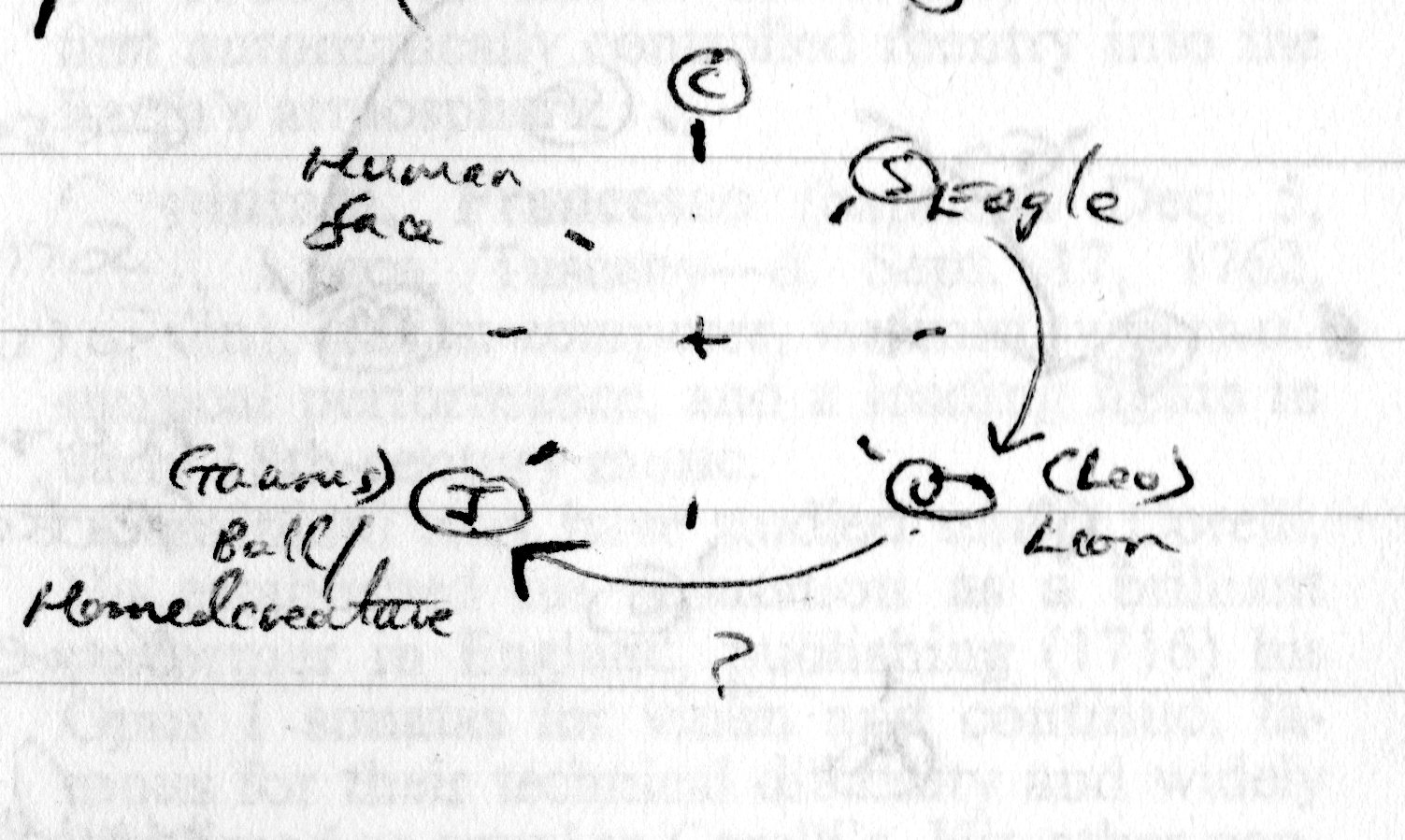
‘Another prevalent motif*was that of an eagle** with spread wings and a leonine head resting its talons on the rumps of stags whose whose heads, in the round, are turned outwards in traditional manner.’

– ibid [E[ncylopaedia of] V[isual] A[rt] 1], 58


*(During the period of the early Sumerian city states, c[irca]3000-2371bc[e])


**[See diagram in last previous entry]


[continued]


[PostedBlogger16for17112022]


{Lions and Horns in Mesopotamia}[20th December 1990]

[Redbook8:127][19901220:0958]{Lions and Horns in Mesopotamia}[20th December 1990]


19901220.0958


‘Many cult vessels decorated in this heavier, later style* feature lions attacking domestic bulls: an epitome of the perpetual conflict in nature.’

– E[ncylopaedia of] V[isual] A[rt], 1:56


**


*during the Early Sumerian period (c3500-3000bc[e]) (later part)


**[re eagle in diagram, see next entry]


[cf [Redbook8:151][19901223:1916k]{More Mesopotamian Symbols [continued (11)] – Bulls and Lions}[23rd December 1990]]


[continued]


[PostedBlogger16112022]


Tuesday, 15 November 2022

Moses the Lawman}*[18th December 1990]

[Redbook8:127][19901218:1026c]{Moses the Lawman}*[18th December 1990]


19901218.1026

[continued]


‘Significantly, though Moses** is compared to a prophet*** in various texts in the Pentateuch (the first five books of the Bible), he is never designated as one – the term being evidently unsuited for so comprehensive and unique a figure.’

– ibid [Encyclopaedia Britannica 22: 402, ‘Judaism’], 405


*{“Big Mo”?}


**ie at c[irca]U~


***(Prophets &c J~-G~-R~)

[But see elsewhere [] quaere as to whether ‘prophets’ belong around S~/s~ or around G~/g~(-R~/r~) – the answer probably depending (as implied here) on the type of ‘prophets’ they actually were]


[PostedBlogger15112022]


Monday, 14 November 2022

{The Biblical Experience of God [continued]}[18th December 1990]

[Redbook8:126][19901218:1026b]{The Biblical Experience of God [continued]}[18th December 1990]


19901218.1026

[continued]


‘The God of the patriarchs* shows nothing of **[the (post-) Mosaic]*** YHWH’s “jealousy”; no religious tension or contrast with their neighbours appears, and idolatory is scarcely an issue.’

– ibid [Encyclopaedia Britannica 22: 402, ‘Judaism’], 404


*ie c1900-1700bce, at c[irca]S~


**[Square brackets [] as in ms]


***ie c1440/1250bce(ff), at c[irca]U~(ff)


[PostedBlogger14112022]


Sunday, 13 November 2022

{The Biblical Experience of God}[18th December 1990]

[Redbook8:126][19901218:1026]{The Biblical Experience of God}[18th December 1990]


19901218.1026


‘[For the Biblical (O[ld] T[estament] authors,]* it was primarily within history that the divine presence was encountered. God’s presence was also experienced within the natural realm, but the more immediate or intimate disclosure occurred in human actions.’

– E[ncyclopaedia] B[ritannica] 22: 402, ‘Judaism’

**


*[Outer square brackets [] as in ms]


**{(cf [[Redbook8:121][19901206:2353]{Direct, Mediated and Dependent Degrees}[6th December 1990],], 121)}

{This is precisely how I see it – except that of course the thought comes even before the action.}


[continued]


[PostedBlogger13112022]


Saturday, 12 November 2022

{“Sphinx to Griffin, Are you receiving me, over?”}[17th December 1990]

[Redbook8:126A][19901217:0000]{“Sphinx to Griffin, Are you receiving me, over?”}[17th December 1990]


17/12/90

*

**

[A photocopy inserted here in the ms of a handwritten letter referenced elsewhere is not reproduced in the ts]


*{cf [[Redbook8:95-96][19901107:1007l]{Sphinx and Griffin}[7th November 1990],] 95,

[[Redbook8:136][19901221:2050]{Sphinx versus Griffin}[21st December 1990],] 136}


**ref VII. [A photocopy inserted here in the ms of a handwritten letter referenced elsewhere is not reproduced in the ts] 133A,

[A photocopy inserted here in the ms of a handwritten letter referenced elsewhere is not reproduced in the ts] 216A


[PostedBlogger12112022]


Thursday, 10 November 2022

{[Insular Cycles and Interference ‘Patterns’ [continued (4)]] – Left & Right Conflict (5)}[13th December 1990]

[Redbook8:125-126][19901213:0050d]{[Insular Cycles and Interference ‘Patterns’ [continued (4)]] – Left & Right Conflict (5)}[13th December 1990]


(12)

13.0050

[continued]

*

It is possible that, in a generally disordered region (of states) and in a long cycle, the short cycle degree will tend to show in the results of inter state (but intra-regional) victories/defeats.


There are indications that M~-type victories within the region tend to be ‘clean’ ie imposing authority but preserving continuity of the defeated populations and lands; whereas G-type victories tend to be ‘dirty’, devastating or destroying the defeated populations and/or lands: either to replace them, or to abandon them.


But this is not yet conclusive.


*[[Redbook8:124][19901211:1500]{Left and Right Conflict (4)}[11th December 1990]→]


[PostedBlogger10for11112022]


{Insular Cycles and Interference ‘Patterns’ [continued (3)]}[13th December 1990]

[Redbook8:125][19901213:0050c]{Insular Cycles and Interference ‘Patterns’ [continued (3)]}[13th December 1990]


(12)

13.0050

[continued]


It’s interesting that although I haven’t really been able to identify short cycles for Mesopotamia and Syria-Palestine – and this may be due to lack of evidence, or just to the lack of detail in my sources – in very modern times, ie after the collapse of the Ottoman Empire,* these areas became subject to European interference and their histories show the same 64-year cycle developing in the last complete period, 1920-1984, as exists in Europe.**


*ref [[Redbook8:44-67][19901027ff]{Comparative Chronology}[27th October 1990],] 67


**{(I haven’t checked earlier periods)}

[– in which case the phrase “became subject to” is presumably premature, or at least conditional]


[(continued)]


[PostedBlogger10112022]


Wednesday, 9 November 2022

{Insular Cycles and Interference ‘Patterns’ [continued]}[13th December 1990]

[Redbook8:125][19901213:0050b]{Insular Cycles and Interference ‘Patterns’ [continued]}[13th December 1990]


(12)

13.0050

[continued]


It is noticeable that the clearest short-period patterns* so far appear in units which, however agitated they may be from time to time internally, are relatively free from outside interference: eg ancient Egypt (a medium-period cycle, I suppose, at 512 years);** mediaeval England-with-Wales (and possibly *** Scotland –I haven’t checked)**** at 64 year cycles within 512 years; and modern Europe likewise.


I guess this may be how you define the area of your cycle:# by finding a relatively self-contained or externally undisturbed size of political territory (eg China) and trying to identify the length of periods of relative internal order and disorder. There is an implication, of course, that the larger the territory, the longer the significant periods.

#*


*[Presumably, the C[ircles] A[nalysis] & S[ynthesis] pattern]


**[Unclear to what this refers: possibly the Early Dynastic Period (c3100-c2686bce), or the Old Kingdom (c2686-c2160bce; or possibly both, in sequence, as the word ‘cycle’ in the ms has been substituted for the deleted word ‘pattern’, & 512 years clearly is not an exact measurement of any single period. c2160-c2040bce was classified as the 1st Intermediate period; c2040-1786bce as the Middle Kingdom; & 1786-1567bce as the 2nd Intermediate Period, followed by the New Kingdom until a period of relative weakness, varying fortunes & foreign domination began from about 1085bce. (Dates (which are not universally agreed) per Encylopaedia Britannica (15th Edition) 18:145ff), the most likely source used at the time of this entry.)]


***ie “-with-” <901220>


****(I haven’t checked mediaeval Europe either)


#{primary?}


#*{See also [[Redbook8:132-133][19901220:1925]{Natural & Historical Cycles}[20th December 1990],] p132}


[continued]


[PostedBlogger09112022]